


€3,802.74
(tax excl.)
€4,639.34
(tax incl.)
Errebi code: 64074
No products
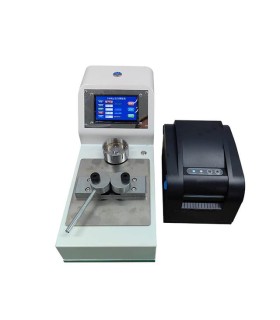
Dynamometers and micrometers are measuring instruments and, specifically, they are used to check the holding force of crimping and to measure the crimping dimensions. Crimping is a very delicate operation, essential for wiring, and involves applying terminals to electrical cables using special machines (presses) which, when periodically monitored, allow working within certain values and parameters to ensure the production of functioning articles that comply with all safety standards. In this context, dynamometers and micrometers prove indispensable because they allow performing resistance tests (with extremely precise results) and verifying that the crimping has been done correctly. This way, the risk of the crimped electrical cables slipping out is avoided and other unpleasant incidents are prevented. Suitable for quality control in the laboratory, these instruments have the advantage of being intuitive and easy to use, as well as handy and safe.
Professional dynamometers come in different types, but the main models most purchased by those working with wiring are digital ones, which are also available in vertical models. Digital dynamometers can also be motorized or not, equipped with a motor. The operation of digital dynamometers is similar regardless of the model: The terminals to be tested (of any type) are fixed using a clamp that adapts to different terminals; the free end of the cable is then inserted into the appropriate housing. At this point, the pulling force is applied (this force can be exerted manually or mechanically depending on the dynamometer model). Finally, after the test is performed, the parameters and values obtained and acquired during the operation are saved and made available for proper monitoring. Depending on the dynamometer model, it is also important to perform periodic maintenance and to use the device according to the instructions in the manual.
Motorized dynamometers have certain functions and technical features that may vary depending on the model used. There are many dynamometers on the market because they are used to measure the force (in this case meaning resistance and holding power) of different types of articles: they are widely used in construction and industrial sectors, and particular dynamometers are essential - as seen - also to test electrical cables: in this latter case, these are instruments capable of performing resistance tests against the slippage of crimped cables. Motorized dynamometers are distinguished by having a motor inside, which facilitates and makes the pulling operations much easier, which do not occur manually but mechanically. Dynamometers for testing crimping of electrical cables differ by the following characteristics:
power supply;
Before purchasing, it is therefore advisable to get informed about all the technical specifications of the model you want to choose, to be sure it meets your needs.
Among the different models on the market, special attention should be given to automatic digital micrometers, which are used to measure the cable diameter by calculating its cross-section. Automatic digital micrometers have many advantages and - given their characteristics - are indispensable for performing precise and professional work. First of all, using an automatic digital micrometer guarantees millesimal precision: the measured values appear clearly on the display and can be read simply and immediately, with conversion between inches/millimeters. Additionally, these instruments automatically correct any measurement errors and the tips allow centering the micrometer exactly on the point to be tested, ensuring an accurate result and a significant time saving. Many automatic micrometers also have a power-off feature if the device is not used for a certain period, thus saving energy.
Automatic micrometers are used to detect crimping dimensions, to measure the height of crimps. The crimp height is a value indicating the dimension of a specific section of the cable (which can be that between the sheath wings or that of the core after crimping tightening). The micrometer works thanks to the movement of a screw which, advancing, pushes a movable cylinder against a fixed element on which the cable to be checked is placed. Testing crimping dimensions is very important because it allows identifying all non-compliant parameters and thus avoiding poor electrical signal transmission or cable slippage. Automatic digital micrometers are useful not only for the extreme precision of measurements but also because they can be used on small wiring, even made with modern and different materials from traditional ones. Furthermore, they can store the analyzed data and make them available for any controls and subsequent monitoring operations.
Measuring instruments, such as dynamometers and micrometers, require simple but constant maintenance, made up of many small operations that, if carried out properly, can guarantee optimal functioning and a long lifespan. Here are the main ones:
These are just some good practices for proper maintenance; naturally, each model will have its own manual indicating all advice and actions to perfectly preserve the purchased item.
From Monday to Friday 9-13 / 14-18
Phone: +39 055.863311
E-mail: [email protected]
Live Chat: from 8:00 to 17:00 Monday through Friday
Skype: ErreBi cablaggi s.r.l.
WhatsApp: +39 3293520566
Telegram: @ErreBi_cablaggi

Please sign in first.
Sign in
Create a free account to use wishlists.
Sign in


 English
 Italiano
 Deutsch
 Français
 Spanish